Last updated October 15, 2026
DIY vs Professional ADU: The San Jose Homeowner’s Decision Guide
California law lets you act as your own general contractor on an ADU project. What the state doesn’t tell you is that Santa Clara County title insurers routinely flag owner-built accessory dwelling units as material defects at resale, and most lenders won’t finance a property with one until the situation is remedied. The DIY-ADU YouTube channels skip that part because their audience doesn’t want to hear it. This guide gives you the full picture from someone who builds ADUs in San Jose for a living: which parts you can legally and safely do yourself, which parts you absolutely cannot, what each path actually costs, and how to decide without losing your shirt or your sanity. For more guides & resources, visit our blog.
Quick Answer
For most San Jose homeowners, the realistic choice isn’t full DIY versus full professional: it’s which components you self-manage and which you hand to a licensed contractor. A true owner-built ADU in California is legal but carries serious resale, insurance, and financing consequences that often erase the money you saved. Most homeowners get the best outcome by handling finish-level tasks themselves (painting, landscaping, some trim work) while hiring licensed professionals for the structural, electrical, plumbing, and mechanical work that inspectors, insurers, and future buyers will scrutinize. If you’re unsure how to vet the right professional, read our guide on How to Hire a ADU Contractor in San Jose: A Step-by-Step Guide.
Table of Contents
- What “Owner-Builder” Actually Means in California
- San Jose ADU Permits and Inspection Rules
- The Real Cost Comparison: Three Paths to an ADU
- How DIY Construction Affects Your Insurance
- What You Can Legally Do Yourself in San Jose
- The Resale and Refinance Problem Nobody Mentions
- Three Questions Before You DIY Anything
- Common Mistakes to Avoid
What “Owner-Builder” Actually Means in California
California has a specific legal status called “owner-builder.” It’s defined in state law as a homeowner who acts as their own general contractor on a construction project on their own property. You sign a waiver at the permit counter acknowledging you are responsible for the entire project: hiring subcontractors, scheduling inspections, ensuring code compliance, worker safety, and all liability. You are, in the eyes of the state, a contractor without a license working on one specific building: your own.
Here’s what that waiver doesn’t say, but what every San Jose ADU contractor knows: owner-builder status follows the property, not the person. When you sell, title companies check whether permits were pulled under owner-builder status. If they were, Santa Clara County escrow officers frequently require a disclosure addendum, and many lenders will simply decline to finance the buyer’s purchase. In our experience, we’ve seen deals fall apart at the 11th hour over exactly this issue.
What You’re Actually Exposing Yourself To
- Liability: If a subcontractor you hire gets injured on your property and you didn’t carry the right workers’ compensation insurance, you are personally liable. Not your project. You. Your home equity, your savings, your future earnings.
- Code liability: When an inspector fails something, the correction order comes to you. If you don’t understand how to fix it, you pay someone to fix it under pressure, usually at a premium.
- Warranty exposure: California law requires builders to stand behind their work for 10 years on latent defects. A licensed contractor carries the insurance and the obligation. An owner-builder carries it personally, and there is no policy that covers it.
- Financing friction: If you ever want to refinance, take out a HELOC, or sell while the owner-builder permit is recent, lenders will ask questions. A lot of questions.
The homeowner route that works is the hybrid one. You don’t have to be the general contractor to be deeply involved in your ADU project in San Jose. You can manage scope, pick finishes, paint the interior, and handle landscaping. You just shouldn’t be the name on the building permit as the contractor of record. The name Sutton comes from an old English word for a south farm: adding a second home to your lot is exactly that kind of settled, rooted decision, the sort of thing worth doing in a way that doesn’t haunt you at closing.
San Jose ADU Permits and Inspection Rules
San Jose was one of the first California cities to adopt a streamlined ADU ordinance, and the current rules are more permissive than most Bay Area jurisdictions. You can build a detached ADU up to 1,000 square feet on nearly any single-family lot in San Jose, regardless of zoning, as long as you meet basic setback and height rules. A setback, for the uninitiated, is the required gap between your new structure and the property line: in San Jose, it’s typically four feet for a detached ADU under city code. That permissiveness is the good news. The bad news is that San Jose still requires full building code compliance, and the inspectors are thorough.
Here is what the city inspection process actually covers on a typical ADU build:
- Foundation inspection: Before concrete is poured, an inspector checks formwork, rebar placement, and anchor bolts.
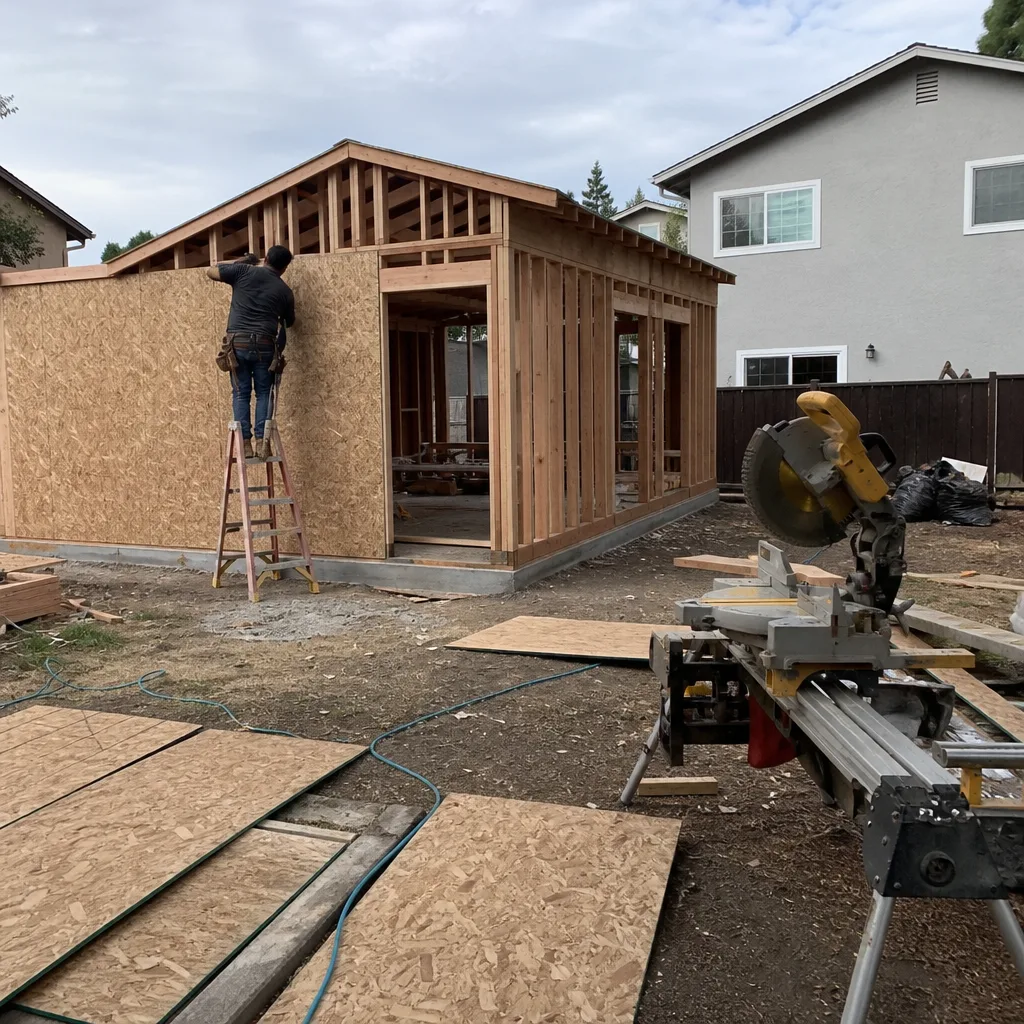
- Framing inspection: Once walls and roof are framed, an inspector verifies structural loads, shear walls, and nailing schedules. This inspection cannot be scheduled by an unlicensed owner who doesn’t understand structural drawings.
- Rough electrical inspection: All wiring must be installed and visible. A licensed electrician’s work is verified against the National Electrical Code.
- Rough plumbing inspection: Drain lines, vent lines, and water supply lines are tested under pressure. A licensed plumber handles this, and San Jose inspectors will ask for the license number.
- Insulation and drywall inspection: Insulation R-values are checked, and drywall is examined for proper screw spacing and fire-rated assemblies where required.
- Mechanical inspection: Heating and ventilation systems are verified. If you’re installing a mini-split, the line set and condensate drain must be visible.
- Final inspection: Everything from door hardware to GFCI outlets to smoke detectors gets checked.
Seven inspections is the minimum for a typical detached ADU in San Jose, and each one is a gate. Fail one, and the next can’t be scheduled until the correction is signed off. A homeowner who has never read a structural drawing will not pass a framing inspection without professional help, which is why the truly owner-built path is functionally unavailable to anyone without construction experience. Our team at Sutton ADU Builders in San Jose manages this entire sequence, and we tell every homeowner the same thing: the inspection process is not the part to learn on the fly.
The Real Cost Comparison: Three Paths to an ADU
Let’s talk real numbers, because the honest math is the most useful thing anyone can give you. Most detached ADUs in San Jose run between $180,000 and $320,000 before site work, depending on size, site conditions, and finishes. Here’s how the three paths compare.
Path 1: Licensed General Contractor
- Cost structure: Contractor’s overhead and profit (typically 15-20% over direct costs), plus licensed trade rates for electrical, plumbing, and mechanical.
- Typical total for an 800-square-foot detached ADU in San Jose: $260,000 to $380,000 including site work, permits, and finishes.
- Timeline: 9-14 months depending on design and permitting load.
- What you get: A licensed contractor carries the liability, schedules the inspections, manages the trades, and stands behind the work. You get a warranty in writing, a permit record that lenders accept, and a project that passes inspection without drama.
Path 2: Owner-Managed Subcontractors
- Cost structure: You save the general contractor’s markup, but you pay retail on every sub, you pay for your own mistakes, and you lose all volume pricing.
- Typical total: $220,000 to $340,000, if nothing goes seriously wrong.
- Timeline: 18-30 months for a first-timer. Add six months for every major inspection failure, and budget for at least one.
- What you get: You are the general contractor. You schedule the foundation guy, the framer, the electrician, the plumber, the roofer, the drywall crew, the painter, and the finish carpenter. When one doesn’t show, the whole sequence stalls. When the inspector fails something, you chase the fix.
- Hidden costs: Rework rates on owner-managed projects in San Jose typically run 8-15% of total project cost, versus 2-4% on professionally managed projects. You also carry the financing cost during a longer timeline, and if you’re renting elsewhere while you build, every extra month is real cash.
Path 3: Full DIY (Owner-Builder)
- Cost structure: You save on labor, which is 40-50% of construction cost. You still pay for materials, permits, engineering, and any trades you’re forced to hire for electrical and plumbing.
- Typical total: $120,000 to $200,000 in direct costs, before you account for the resale discount you may take later.
- Timeline: 2-5 years for a working homeowner with a full-time job. Some people never finish, and San Jose permits expire if work stops for too long.
- What you get: A structure that may work fine, but a title history that will complicate your exit. The insurance gaps alone, which we cover next, can cost more than the labor you saved.
How DIY Construction Affects Your Insurance
This is the section that most ADU guides skip entirely, and it’s the one that matters most for San Jose homeowners. Your homeowners insurance policy has specific exclusions for construction activity, and how you build your ADU determines whether those exclusions apply to you.
During Construction
If you hire a licensed general contractor, their insurance covers the project during construction: general liability, workers’ compensation for their crew, and builder’s risk if they choose to carry it. Your existing homeowners policy typically remains in force with a simple endorsement. If you act as owner-builder or manage your own subcontractors, your standard homeowners policy will not cover construction injuries on your property. You need a separate course of construction policy, which runs $1,500 to $4,000 for a typical San Jose ADU build, and if you don’t have workers’ comp coverage for the people you hire, you’re personally exposed.
After Construction
This is the part nobody talks about. Once your ADU is complete, your insurance carrier will ask who built it. If the answer is “a licensed contractor with a permit history,” the renewal is usually straightforward. If the answer is “I did, under an owner-builder permit,” some carriers will decline to cover the ADU at all, and others will write the policy with a construction-defect exclusion. That means if your owner-built ADU develops a roof leak or an electrical fault, you have no insurance coverage for the damage. Our home addition work in San Jose has taught us that insurance underwriters are far less forgiving than city inspectors, and they ask harder questions after the fact.
What You Can Legally Do Yourself in San Jose
This is not a “never do anything yourself” guide. There are specific tasks that are legally owner-performable in San Jose, that don’t require a licensed trade, and that pose no meaningful risk to you or to the future resale of your property. The distinction is simple: if the task requires a trade license to pull a permit, it’s not a DIY task. If it doesn’t, it’s fair game.
Legally Owner-Performable Tasks
- Interior painting: No license required, no permit required. This is the single best DIY task on any ADU project, and it saves $4,000 to $8,000 depending on square footage and finish level.
- Landscaping and irrigation: After the foundation is in and the structure is weather-tight, all exterior grading, planting, and irrigation work is owner-performable. San Jose has specific water-efficient landscaping requirements, but you can meet them without a licensed contractor.
- Finish carpentry: Baseboards, door casing, shelving, and cabinet installation are all legal for a homeowner to perform. The material cost is real, but the labor savings on a typical 800-square-foot ADU run $6,000 to $12,000.
- Flooring installation: Engineered wood, laminate, tile, and vinyl plank flooring are all owner-performable. Tile in wet areas is trickier because a failed waterproofing membrane can cause serious damage, but the law allows it.
- Demolition of non-structural elements: If you’re converting a garage or interior space, you can legally pull a demolition permit and remove drywall, flooring, and non-load-bearing framing yourself.
Tasks That Require Licensed Trades, Full Stop
- Electrical: Under California law, any electrical work beyond replacing a light fixture requires a licensed electrician. Your ADU’s electrical rough-in, panel work, and service connection are not DIY territory.
- Plumbing: Drain lines, supply lines, and gas lines require a licensed plumber. San Jose inspectors will verify the license number on the permit.
- Structural framing: The framing inspection is the most consequential gate in the entire process, and a first-timer will not pass it. Structural work is best left to licensed professionals.
- Roofing: A roof failure on a structure you built yourself is a visible, expensive problem. This is not a place to learn.
- HVAC: Refrigerant lines, ductwork sizing, and combustion safety are licensed trades. A botched mini-split install can create moisture problems that ruin a wall cavity before you know there’s a problem.
If you’re considering a prefab or modular ADU for your San Jose property, the DIY calculus shifts. Products from companies like Dvele and Plant Prefab ship as factory-built modules that arrive on a truck, and the factory handles the structural, electrical, and plumbing build-out under controlled conditions. That doesn’t eliminate the need for a contractor: you still need site prep, foundation work, utility connections, and crane setting, all of which are permitted and inspected. But it does compress the on-site timeline and reduce the number of trades on your property. Our room addition experience in San Jose tells us that prefab is the best fit for homeowners who want the efficiency of factory construction without the owner-builder liability.
The Resale and Refinance Problem Nobody Mentions
Here is the paragraph that will save you more money than anything else in this guide. When you sell a home in San Jose with an unpermitted or owner-built ADU, the buyer’s lender will order an appraisal, and the appraiser will check the permit history. If the ADU was built under an owner-builder permit, the appraiser will note it, and the underwriter will ask questions. Some lenders have automatic overlays that decline any property with a recent owner-builder history. Others will require a structural engineer’s certification, which runs $1,500 to $5,000, and even then, some buyers will simply walk.
The same problem appears if you want to refinance. A homeowner who built an ADU under owner-builder status and then tries to pull equity two years later often discovers that the ADU appraises at zero, because the lender can’t verify construction quality. You built a $250,000 asset that the bank values at nothing, at least until significant time passes and you can demonstrate that the structure has been rented for years without issue. In San Jose’s market, where ADUs are common and appraisers are experienced, the scrutiny is real.
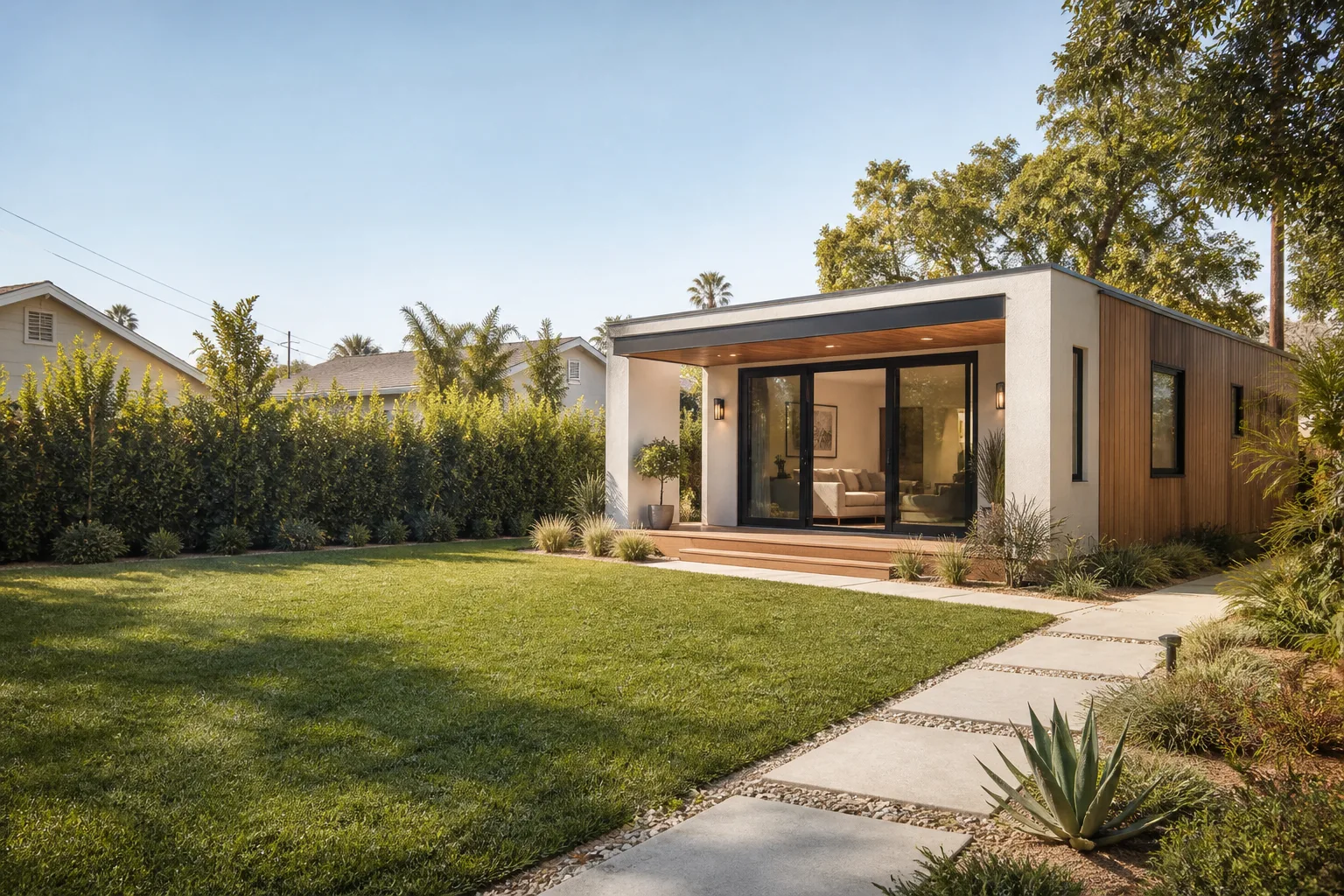
Build it with a licensed contractor, and the calculus flips. The permit record shows a licensed general contractor, the appraiser values the ADU at its cost basis or market comp, and the lender treats it as a normal accessory dwelling unit. When you eventually sell, the ADU becomes a selling feature instead of a disclosure burden. Sutton ADU San Jose builds every project with the eventual sale in mind, because the single best day to think about resale value is the day you pull the permit.
Three Questions Before You DIY Anything
Before you pick up a paintbrush or sign an owner-builder waiver, ask yourself these three questions. Answer them honestly, and the decision makes itself. We’ve walked hundreds of San Jose homeowners through this exact conversation, and the pattern holds.
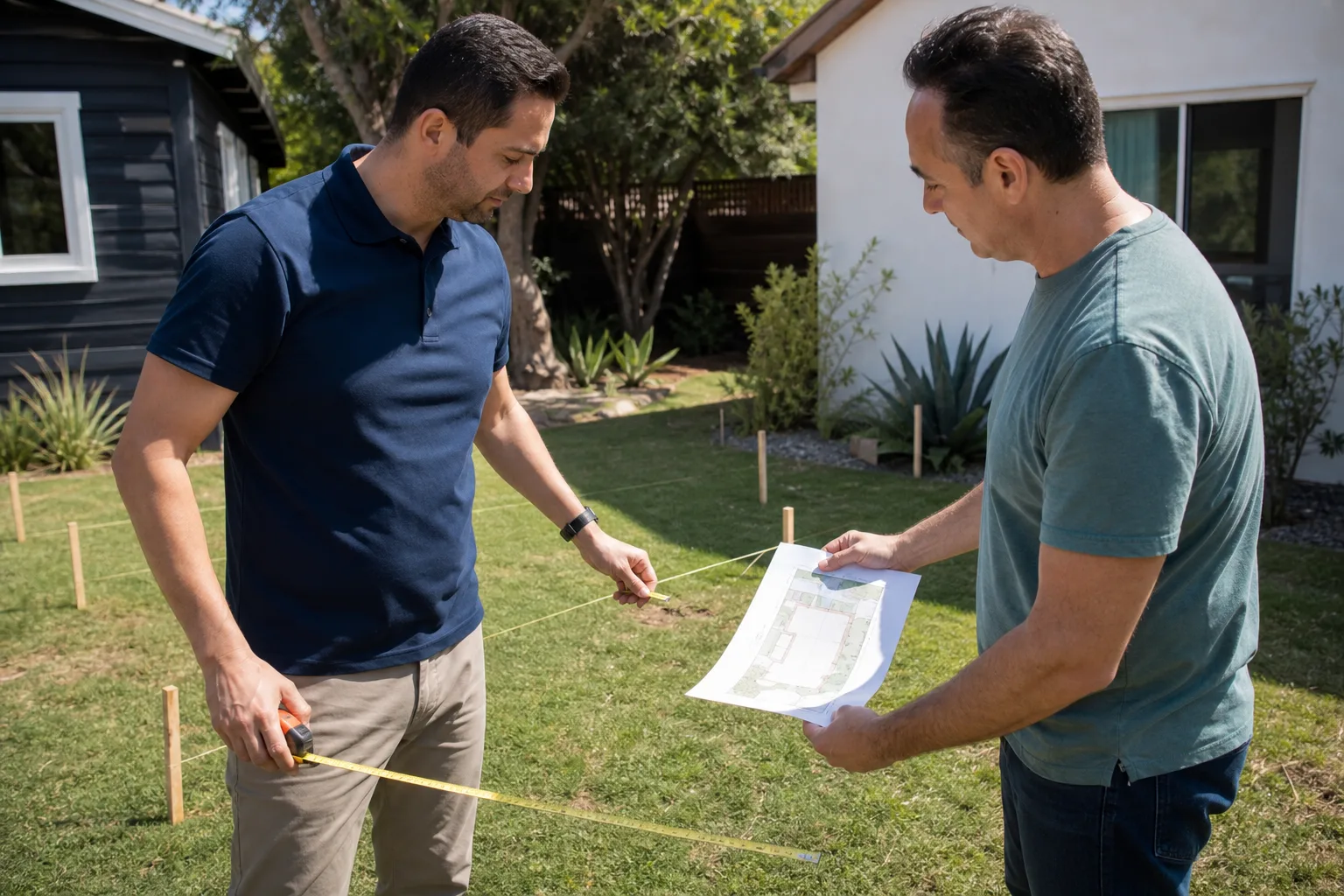
- Can you pull the permit? Not “can you find the form online.” Can you sit at the San Jose permit counter and accurately describe the scope, the trades involved, and the inspection sequence? If the answer isn’t an immediate yes, you should not be the permit holder. Hiring a contractor to pull the permit and manage inspections while you handle finish work is the hybrid model that works.
- Can you pass the inspection? Passing a San Jose building inspection requires knowing the code as it’s written, not as it’s discussed on forums. The framing inspection alone requires understanding shear wall nailing schedules, hold-down placement, and lateral load paths. If you can’t explain what any of those are without looking them up, you will fail the inspection, and every failure adds weeks to your timeline.
- Can you document it for a future buyer’s lender? This is the one that separates a good DIY project from a liability. When you sell in ten years, can you produce a complete permit history, a construction record, and professional documentation that an underwriter will accept? If the answer is anything less than yes, you’re trading short-term savings for long-term cost.
If you answered honestly and got a “no” on any of them, the right move is clear: hire a licensed contractor for the structural and systems work, and keep the finish-level tasks for yourself. Sutton ADU San Jose offers free estimates in San Jose, and our Sutton ADU San Jose home page walks through what a professionally managed project looks like from initial consultation to final inspection. You’ll also get written pricing before any work begins, which means you can compare our number against the DIY path with real data in hand.
Common Mistakes to Avoid
- Assuming owner-builder permits are “no big deal.” They are a big deal at resale, at refinance, and at insurance renewal. The savings look real on day one and evaporate on day 3,650 when you try to sell.
- Underestimating the inspection gauntlet. San Jose’s inspection process is sequential and unforgiving. One failed framing inspection can stall your project for a month while you find and hire a professional to fix the work.
- Skipping the builder’s risk policy. If your ADU burns down mid-construction and you were acting as owner-builder without a course of construction policy, the loss is yours. Fully yours. That’s a $200,000 mistake on a bet that nothing would go wrong.
- Trusting online cost calculators for San Jose. Bay Area labor rates, permit fees, and material costs are significantly higher than national averages. A calculator that says $150,000 is optimistic in San Jose by $50,000 or more.
- Underestimating the time cost of self-management. Owner-managed ADU projects in San Jose routinely take 2-3 times longer than professionally managed ones. If you’re paying a mortgage on the property, every extra month is a direct cost.
- Hiring unlicensed subcontractors to save money. An unlicensed electrician’s work will fail inspection, and San Jose inspectors are specifically trained to spot it. You’ll pay twice: once for the bad work, once for the licensed professional who fixes it.
- Building a detached ADU “temporarily” without permits. San Jose’s code enforcement discovers unpermitted structures through aerial imagery, neighbor complaints, and utility usage patterns. The correction order is expensive, and red-tagging your ADU means you can’t rent it, insure it, or include it in an appraisal.
When to Call a Professional
Call a professional if your ADU plan involves any structural change to an existing building, any new electrical service, any plumbing rough-in, or any roof work. Call a professional if you’re converting a garage and the slab needs to be lowered or the framing needs to be modified. Call a professional if the property is on a slope, has drainage issues, or if the ADU will sit within four feet of the property line. And call a professional if you want a written price before work begins and a guarantee that covers the work for a full year after completion. Sutton ADU San Jose offers free estimates in San Jose: call (669) 444-4530, and you’ll speak to a live person who can walk you through the numbers.
Frequently Asked Questions
Yes, California allows owner-builder permits for ADUs, but doing so exposes you to personal liability for construction defects, makes your insurance coverage uncertain during and after construction, and creates a title issue that many lenders will not finance at resale.
Most detached ADUs in San Jose run $260,000 to $380,000 with a licensed general contractor, including site work, permits, and finishes. Prefab and modular options can reduce that to $220,000 to $300,000 depending on the product line and site conditions.
Homeowners can legally handle interior painting, flooring installation, landscaping, irrigation, finish carpentry, and non-structural demolition without a contractor’s license. Electrical, plumbing, structural framing, roofing, and HVAC all require licensed trades under California law.
Yes, in most cases. Santa Clara County title insurers and mortgage underwriters treat recent owner-built ADUs as a material risk, which means buyers may struggle to get financing, and you may be forced to accept a lower price or pay for a structural engineer’s certification before closing.
Yes. We have experience with Dvele, Plant Prefab, and Mighty Buildings product lines, and we help homeowners evaluate whether a factory-built ADU fits their lot, budget, and timeline better than a stick-built structure.
A typical detached ADU in San Jose takes 9 to 14 months from design to final inspection, depending on permit load at the city and the complexity of the site. Prefab options can compress that to 6 to 10 months. Owner-managed projects commonly take 18 to 30 months or longer.
The Bottom Line
The DIY-versus-professional framing is the wrong question. The right question is: which parts of this project can you genuinely do yourself without creating a liability that will follow you for years? In San Jose, the answer for most homeowners is the finish work: painting, flooring, landscaping, trim, and maybe some light demolition. Everything else, from foundation through framing through electrical and plumbing, belongs in the hands of licensed professionals who carry the liability, pass the inspections, and leave a documentation trail that protects your investment when you eventually sell. Sutton ADU San Jose has been building and managing these projects in San Jose since 2006, and the pattern is consistent: the homeowners who stay involved in the right ways get the best outcomes. The ones who try to do everything themselves usually learn an expensive lesson.
Written by Miles Hartwell, Owner at Sutton ADU San Jose, serving San Jose since 2006.